I'm excited to be awake.
In honor of spring, and due to a backlog of unwritten posts, I would like to take this time to reflect upon some pieces of writing that have accumulated in the bottom of my bag. They might seem like a hodgepodge of irrelevant works- a poem about splitting wood, an abridged essay on practicing guitar, and half a chapter on happiness- but each bring thoughts about my project.
So this post is dedicated to a poem
Now I hate to take apart a poem and present each stanza as a separate entity, but to give background and scope to Robert Frost's poem Two Tramps in Mud Time I have extracted the 1st, 6th, 8th, and 9th stanzas.
Out of the mud two strangers came
And caught me splitting wood in the yard,
And one of them put me off my aim
By hailing cheerily "Hit them hard!"
I knew pretty well why he had dropped behind
And let the other go on a way.
I knew pretty well what he had in mind:
He wanted to take my job for pay.
And caught me splitting wood in the yard,
And one of them put me off my aim
By hailing cheerily "Hit them hard!"
I knew pretty well why he had dropped behind
And let the other go on a way.
I knew pretty well what he had in mind:
He wanted to take my job for pay.
.....
The time when most I loved my task
The two must make me love it more
By coming with what they came to ask.
You'd think I never had felt before
The weight of an ax-head poised aloft,
The grip of earth on outspread feet,
The life of muscles rocking soft
And smooth and moist in vernal heat.
The two must make me love it more
By coming with what they came to ask.
You'd think I never had felt before
The weight of an ax-head poised aloft,
The grip of earth on outspread feet,
The life of muscles rocking soft
And smooth and moist in vernal heat.
.....
Nothing on either side was said.
They knew they had but to stay their stay
And all their logic would fill my head:
As that I had no right to play
With what was another man's work for gain.
My right might be love but theirs was need.
And where the two exist in twain
Theirs was the better right--agreed.
They knew they had but to stay their stay
And all their logic would fill my head:
As that I had no right to play
With what was another man's work for gain.
My right might be love but theirs was need.
And where the two exist in twain
Theirs was the better right--agreed.
But yield who will to their separation,
My object in living is to unite
My avocation and my vocation
As my two eyes make one in sight.
Only where love and need are one,
And the work is play for mortal stakes,
Is the deed ever really done
For Heaven and the future's sakes.
My object in living is to unite
My avocation and my vocation
As my two eyes make one in sight.
Only where love and need are one,
And the work is play for mortal stakes,
Is the deed ever really done
For Heaven and the future's sakes.
some thoughts-
In the second stanza he describes his act of splitting wood as
"blows that a life of self-control spares
to strike for the common good
that day, giving a loose to my soul,
I spent on that unimportant wood"
He splits wood not because of an immediate need, but presumably for relaxation. And so as the tramps wander past, the stark contrast between the connection of the wood chopper to splitting wood "a loose to my soul, I spent on that unimportant wood", and the tramps to splitting wood, " theirs was need", creates a revelation of sorts-
"You'd think I never had felt before
The weight of an ax-head poised aloft"
Their is a newfound appreciate for a task he is not bound to for livelihood, but can enjoy at will.
and then in the final stanza the message becomes clear
" my object in living is to unite
my avocation and my vocation"
Joy should not come from only hobbies, and work shouldn't just be exclusively to support oneself.
Who better understands this than kids; ask them what they want to do when they get older, " I want to be in the NBA, I want to be a safari guide, I want to be a superhero." Work should be fun.
Yet it is even more, for... "only where love and need are one
and the work is play for mortal stakes
Is the deed ever really done
For Heaven and the future's sakes"
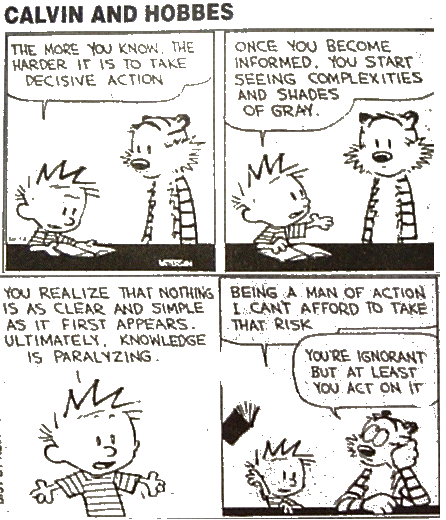
For mortal stakes, where love and need meet, there is where our work lies. As MLK said "Social action without education is a weak expression of pure energy. Deeds uninformed by educated thought can take false direction"
For me this is sustainability-- work for mortal and future's stakes.
I've come to a point so close to deciding what direction I will take this next year that I find myself coming back to these ideas over and over again. I think of Scott, the potter that I interviewed a couple weeks ago; to me his work is his education and his pottery is his mode of social action.
I think about how some Universities have become heavily funded and controlled by certain pharmaceutical and agribusiness sectors. I think how school has taught me to go through the motions, but hasn't taught me to question what I learn. As Dominic Frongillo told me in our interview, "I grew up knowing the world could be a better place and I couldn't stand not dedicating my time to making it one"
I could earn fabulous grades and innumerable accolades from my teachers, attend Harvard and go on to work for Monsanto developing bt potatoes, or Chesapeake Energy to engineer new machinery for drilling natural gas, or Merk to market a new blockbuster bladder control drug, or even McDonalds as a synthetic food specialist. Now surely I would earn bushels of money; and rightfully so because I would be working hard, but could I look myself in the mirror and call myself intelligent? No. I think half the problem with the direction our country is going is we aren't playing for mortal stakes. As a capitalists society we value economic success a bit more than we should, while ignoring the implications of affluence without social action.
We can just as easily value working for each other more than we value beating each other.
a life of self-control spares
to strike for the common good

I am considering becoming a farmer.

No comments:
Post a Comment