Wednesday, March 30, 2011

Gardening thing

Bonjour! Cava? Oui Cava bien. bon!

sorry you caught me at a bad time, just practicing my french.
well I guess you could stay and we could chat a bit....

Last night I had dinner with a small group of people working on getting kids at Caroline outside and into nature. I know, amazing concept. It was a pleasure to feast on quiche and discus with former Caroline teacher (and host)- Janie Clark,  and current graduate student in landscape architecture,Tim Lynch, as well as  John Weissenger, author of many animal books, about incorporating a school garden into their master plan for a wilderness area. I must say it's exciting to be around so many amazing and supportive people. I took some notes, which I will post up later.  In short, we talked about possible 3 possible areas for the garden, compost options, soil testing, community involvement, construction, handicap access, and curriculum ideas.   There is a surprisingly copious amount of school garden sites, with everything from building raised beds to teaching kindergardeners about worms. I know i most likely wont be around to see this idea completely through, but as Mrs. Clark said, we are building a house and our small group is the architect. The biggest dragon we must slay is creating a master plan  to submit to the state. Unfortunately for us you cant take public school grounds and put what ever you want on it.

A elementary school garden, available to the public, filled with radishes, kale, carrots, and everything in between, might not seem like much, but in my mind it would be fantastic- on par with taking a ski trip. As consumers, food is our number one way we vote with our dollars, and we cast our ballot every day. Getting kids, who (if they were anything like me) bug the brain cells out of their parents, involved in this outmost important local, sustainable, food movement.  Its been shown that kids eating habits are influenced at a very young age, and if it begins young enough a kid raised on kale chips and tomatoes will prefer eating said gross food for the rest of his/her life. You've got to start young!


Saturday, March 26, 2011

1 month plan

Yes, I just got a mac book pro. Its neck-breaking speed, and impeccable design has you chomping at the bit for your own. 55 more hours of scraping paint, filing files, folding papers, and other busy work and I'll have this bad boy paid off, but for now I bask joyfully in its light. You've got to love techiminology.

As usual I have much to say,but this post will be quick and bulleted-- a outline of the next month.

plan for next wave of blogposts

  • Healthcare system parallels to agricultural system
  •  happiness and sustainablity
  • thoughts on films
  •  
Plan for next month

week 1.) 27-31=finishing food
  •   Green building series 7-9 on wednesday
  •   Caroline garden meeting Tuesday 6:30
  •   Snow farm  interview
  • go to commons and interview people
  • and of course finish reading
  • get I movie stuff transferred to new laptop

week 2 & 3.) 1-16=transportation

  • Concentration on transportation 
  • green building lecture 7-9
  • talk to Tim Logue(make sure to get referred to other locals involved in transportation)- city trasnport engineeer and Mrs. G's hubby
  • talk to Tom Knipe- biking guy
  • talk to Jacob Roberts - pod car guy
  • read Sustainable Transportation and other books
  • limit driving (Sweet lord I've been driving way too much)
week 4 & 5.)  17-30=home energy use

  • have home audit 
  • follow energy efficiency path  put out by CCE
  • read The Green House
  • read The Solar House
  • visit house up the road that is passive solar
  • interview Ithaca green building alliance organization
  • contact community building works


I am having difficulties with attending local events when baseball is every day. I really want to attend the youth power summit April 8th, but have a game. Soon games start and then everything is going to get terribly hectic.

Wednesday, March 23, 2011

Lessons of a Tramp

Yes! It's a snow day, I slept 13 hours last night, and just killed 2 hours doing nothing.
 I'm excited to be awake.

In honor of spring, and due to a backlog of unwritten posts, I would like to take this time to reflect upon some pieces of writing that have accumulated in the bottom of my bag. They might seem like a hodgepodge of irrelevant works- a poem about splitting wood, an abridged essay on practicing guitar, and half a chapter on happiness- but each bring thoughts about my project.

So this post is dedicated to a poem

Now I hate to take apart a poem and present each stanza as a separate entity, but to give background and scope to Robert Frost's poem Two Tramps in Mud Time I have extracted the 1st, 6th, 8th, and 9th stanzas.   

Out of the mud two strangers came
And caught me splitting wood in the yard,
And one of them put me off my aim
By hailing cheerily "Hit them hard!"
I knew pretty well why he had dropped behind
And let the other go on a way.
I knew pretty well what he had in mind:
He wanted to take my job for pay. 
.....
The time when most I loved my task
The two must make me love it more
By coming with what they came to ask.
You'd think I never had felt before
The weight of an ax-head poised aloft,
The grip of earth on outspread feet,
The life of muscles rocking soft
And smooth and moist in vernal heat. 
 .....
Nothing on either side was said.
They knew they had but to stay their stay
And all their logic would fill my head:
As that I had no right to play
With what was another man's work for gain.
My right might be love but theirs was need.
And where the two exist in twain
Theirs was the better right--agreed. 

But yield who will to their separation,
My object in living is to unite
My avocation and my vocation
As my two eyes make one in sight.
Only where love and need are one,
And the work is play for mortal stakes,
Is the deed ever really done
For Heaven and the future's sakes.


some thoughts-
In the second stanza he describes his act of splitting wood as
"blows that a life of self-control spares
to strike for the common good
that day, giving a loose to my soul,
I spent on that unimportant wood"


He splits wood not because of an immediate need, but presumably for relaxation. And so as the tramps wander past, the stark contrast between the connection of the wood chopper to splitting wood "a loose to my soul, I spent on that unimportant wood", and the tramps to splitting wood, " theirs was need", creates a revelation of sorts-
 
 "You'd think I never had felt before
The weight of an ax-head poised aloft
"

Their is a newfound appreciate for a task he is not bound to for livelihood, but can enjoy at will.

and then in the final stanza the message becomes clear

" my object in living is to unite 
my avocation and my vocation"

Joy should not come from only hobbies, and work shouldn't just be exclusively to support oneself.
Who better understands this than kids; ask them what they want to do when they get older, " I want to be in the NBA, I want to be a safari guide, I want to be a superhero." Work should be fun.
Yet it is even more, for... "only where love and need are one
and the work is play for mortal stakes
Is the deed ever really done
For Heaven and the future's sakes"

 
For mortal stakes, where love and need meet, there is where our work lies. As MLK said "Social action without education is a weak expression of pure energy. Deeds uninformed by educated thought can take false direction" 
For me this is sustainability-- work for mortal and future's stakes.

I've come to a point so close to deciding what direction I will take this next year that I find myself coming back to these ideas over and over again. I think of Scott, the potter that I interviewed a couple weeks ago; to me his work is his education and his pottery is his mode of social action. 
I think about how some Universities have become heavily funded and controlled by certain pharmaceutical and agribusiness sectors.  I think how school has taught me to go through the motions, but hasn't taught me to question what I learn. As Dominic Frongillo told me in our interview, "I grew up knowing the world could be a better place and I couldn't stand not dedicating my time to making it one"


I could earn fabulous grades and innumerable accolades from my teachers, attend Harvard and go on to work for Monsanto developing bt potatoes, or Chesapeake Energy to engineer new machinery for drilling natural gas, or Merk to market a new blockbuster bladder control drug, or even McDonalds as a synthetic food specialist. Now surely I would earn bushels of money; and rightfully so because I would be working hard, but could I look myself in the mirror and call myself intelligent? No. I think half the problem with the direction our country is going is we aren't playing for mortal stakes. As a capitalists society we value economic success a bit more than we should, while ignoring the implications of affluence without social action.

We can just as easily value working for each other more than we value beating each other. 

a life of self-control spares
to strike for the common good


I am considering becoming a farmer.


Monday, March 21, 2011

Knick Knacks

As much as I would love to have every post pertain to research it is time to reflect upon some of the more drier aspects my wise project. It's cool we can get through this, together.

My last mentor meeting passed as I guilt tripped myself and Mrs. G  listened, wise and nonjudgmental. For those of you who have seen 8 Mile I was Slimshady who told everything wrong about his life before the other rapper could. Unfortunately I was not rapping and there were no girls cheering for me in the crowd.
Nevertheless, with Drizzy G by my side I did receive some uplifting guidance.

First lets outline the plan for the next 2 weeks-

  • Finish Omnivores Dilemma 
  • Watch Food Matters
  • Actually get the camera from Sean A. (ya I know I'm bad)
  • research/ ponder how to spread what you know to the people who don't know (and frankly need to know)
  • get a haircut
  • Contact and possibly interview local farmer Mr. Snow
  • do 10 posts

Next lets talk about other things Drizzy G and I discussed

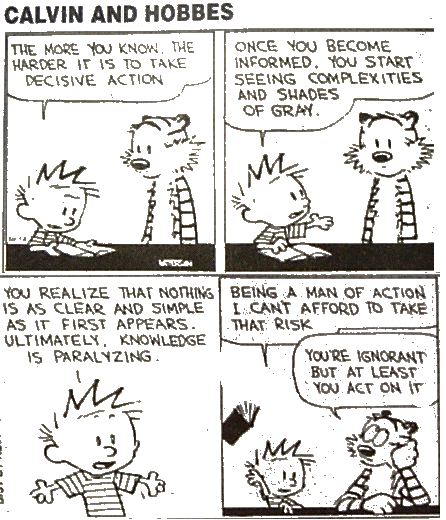
How I feel ambivalent about having screenings of the movie. I don't want to tell people how to live, nor do I believe I have enough experience or grasp of such a complex issue. Just asking- should we import organic eggplant from Argentina?, produces an unwanted tangle of gray answers. We agreed I could either become a super genius or just say what I know and be willing to say I don't know.

finally-Back planning- June is coming whether I tell it to or not. I need to take out a calendar and see how to best budget my time.

speaking of time
t t f f__ta ta for now

Sunday, March 20, 2011

3 a day- burgers and fries. blog posts and wise

"There are no shortcuts in life"

I heard it at a friends house last year, as I sipped on some milk at his table.
My buddy's older brother said it;  I remember it distinctly.

He was talking about studying for the SAT's , and yet now a year later,  as I read about cows, corn, and nitrogen fertilizer I can't think of a better aphorism for something completely different- farming.

The way we produce industrial food is a shortcut, an artificial means, to make food cheap. But life, the sustainable cycle of symbiosis, doesn't have shortcuts.

These days it is easier than ever to produce mass amounts of food. One farmer can feed over 120 people, an absolute marvel of technological and agricultural achievement. It used to be every 1 in 4 people was a farmer. In the 1920's a farmer could brag about a 25 bushels per acre yield of corn; these days if you aren't pushing 170 bushels per acre you're loosing respect and possibly your farm.
Not only is the average American unencumbered from growing their own wheat, but they are also able to spend a meager 9% of their disposable income on food (as opposed to 25% in 1930).  It's an incredible feat, which owes thanks to hybrid seeds, chemical fertilizers, pesticides, super-sized tractors, and strategic government planning. But bigger isn't always better, and this tremendous growth has come at a price.

-How I understand it-
Information gathered from Omnivores Dilemma, King Corn, The Future of Food, and Fast Food Nation

Lets concentrate on America's numero uno crop-- corn.
Iowa has some of the richest soil in the US, and yet it imports 80% of its food. 2.438 billion bushels of corn flow annually from the Kingdom of Corn, and almost none of it is edible, at least not right off the stalk. 
No, this is industrial corn, destined for ascorbic acid, ethanol, plastics, and cows. You don't eat it silly.


America produces a hell of a lot of corn. It overflows grain elevators, it fills our cars, and it fills our stomachs till they overflow our T-shirts.
How come?
Most corn in the U.S is grown on 100+ acre farms in the Midwest, and requires at-least two things- pesticides and fertilizers. 


In 1909 Fritz Haber discovered a most fantastic thing- how to fix nitrogen to hydrogen. Previously this process was under the exclusive responsibility of nitrogen fixing bacteria on leguminous plants. But hail the human, for now under intense heat and pressure hydrogen atoms from oil could be bonded to nitrogen atoms. A fundamental compound of life was no longer emitted at the discretion of the ever mundane and predictable soybean. But it wasn't until after WWII, when chemical factories began looking for new uses to their main ingredient in explosives, that chemical fertilizers really changed the game. The nitrogen that destroyed Germany is now the food of modern day hybrid corn.  Before corn could only be grown on the same field twice every five years. Before crops needed to be rotated, so fields could be replenished by legumes and cow manure. Before we had less corn. Now we can satisfy corns unmatched thirst for nitrogen, adding 100+ pounds per acre. But not all of it ends up in the soil; excess nitrogen runs off and ends up in the gulf of Mexico (making huge algae booms which cause dead-zones where fish cannot live), it seeps into our water tables, and resides in our ever beloved acid rain.
Yet, corn can be planted year after year. But again this is an articial means to an end. It is unsustainable- farmers now put in 2 calories of energy into soil for every calorie reaped.  The overfarming that led to the Dust bowl of the 1930s still exists. We are pushing the soil to its maximum output. But in doing so we are raping soil of its nutrients and eroding the topsoil. Iowa used to have 8 feet of topsoil and today it only has 4.  An industrial farm no longer gets its energy from the sun, from cow manure, or from bacteria, it has found a faster alternative--fossil fuel based fertilizer. Soil is an organism of complexity we will never fully grasp. By reducing it to three main componets: nitrogen, phosphorus, and potassium, supplied in fertilizer, we are oversimplifying its needs. Plants grow because they have the base compounds, but the soil in which they live is dead. And dead soil leads to vulnerable plants

Thus to keep these plants in unnaturally close proximity, keep them healthy, and to ward off pests, you need another chemical- a pesticide. One things leads to another.
Again it was WWII that caused the advent of chemical pesticides- nerve gas was modified to kill only bugs, at least that was the intention. Monocultures could be blanketed in pesticide so that having multiple crops, incase one failed, became obsolete. DDT became the symbol of 3 decades of triumphant pest control. What, it causes cancer? we never knew....

And as chemical companies soon became an essential of the American farm durring the dawn of the 1950s their influence spread. Chemical companies like Monsanto began buying up seed companies long ago. Just recently Monsanto purchased the largest vegetable seed company in the world. The seeds Monsanto produces are self terminating. The a most basic function of the agragrian system-- saving seeds for the next planting-- has been undermind. But it is fantastic for business; If you control the seeds and you controll the pesticides that safeguard the plants, you controll the prices and the food.


There were decades of denial that pesticides caused any harm. It wasn't untill recently that Monsanto admited the extremely toxic dioxin-- Agent Orange--spread over most of Vietnam in 1970, was actually harmful. DDT, a carginogen, was claimed entirely safe.
However now as pesticides continue to leave a bad taste in consumers mouths we are told not to worry, GMO foods are here to save the day. Now chemical companies control thousands of genes. it is estimated that Monsanto controls 90% of seed genes. Life can now be patented. 


GMO foods are another issue in and of their selves, which I don't wish to get into.
 However it must be clear that there is a sufficient lack of regulation. George Bush's administration made it so that GMO foods did not need to be regulated any differently than conventional produce. GMO food does not need to be labeled and problems with cross contamination has already emerged.
 Promised increases in yield have been minimal at best, and the risks of tampering with millenniums of evolution and plant diversity are immense. What happens if a self-terminating seed cross pollinates? And why do we need more when we have a severe-problem of overproduction?
 It is the paradox of industrial farming that 1st world countries over-eat while 3rd world countries starve. There is now more overweight than malnourished people in the world. Cheap corn from industrial countries outcompetes 3rd world farmers in places like Mexico where imported corn is 3 pesos cheaper per bushel. We have a food distribution problem, an inequality problem, not a technological problem. Subsistence farmers in third world countries are kicked off their land as bigger farms move in. Instead of being independent producers they become dependent consumers. 


but enough with that

Now because your probably eshausted from staring at your computer screen. lets take 5 and comeback.

Soooo now you don't need cows, and you don't need a heterogeneous mixture of crops; you can plant one monotonous mile of corn upon mile of corn until your eyes turn golden yellow. 
But why? Corn is an extremely compact form of energy.


But more importantly...
 Previous policies, instituded durring the Great Depression, insured that farmers could earn a living, set a natural price for corn. If the market price of corn was to go below that price a farmer could take out a government loan, using his grain as collatoral, to store his crop. This encouraged farmers not to sell when prices were low and further weaken the market. When the prices went back up they could pay back the loan and sell the corn. These loans were relatively low risk for the government;  if the price didn't rise the government would keep the corn, and the farmer kept the loan. The government then stored the corn in a national granary to be used in times of crop failure, providing food security, or sold when prices were high. Again, that was before. Beginning in the 50's such policies slowly dissolved. In the 1970's fear over high grain prices-- due to grain transactions with Russia--led to a complete overhaul of our agriculture policy. Lead by the Reagan administration, the push for maximum output began. As grain prices fell small farms were eaten up by large conglomerates .

From that point forth, growing large monocultures like corn relied on government subsidies.
Now, half  of an Iowa farmer's income comes from the government. And where does that money come from? The US taxpayers who spend $25 billion a year to support farmers! It costs a farmer around $3.20 to produce a bushel of corn, and they sell that corn at $2.20 a bushel. That is a net loss of a $1.00 per bushel. Now how in the world is that a viable business model.
Farmers sell at any price, further weakening the market, because they receive deficiency payments from the government that cover their losses. George Bush just a few years ago signed the largest corn subsidy bill of its time. Farmers are loosing money because of direct government policy.
It should be clear why we have fewer farmers than ever...


Once farmers dump their corn at the local granary, (most of which only take corn or soybeans), they no longer have a connection to it; it's simply one more drop in an ocean of 10 billion bushels.

But where does all this corn go and who benefits?
It goes to ethanol
it goes to sweeten everything
It goes anywhere
Most of it goes to feed cows, because it fattens them faster then grass. Unfortunately because they are ruminants it slowly kills them. Cheap corn is the reason you can have a burger for $1.08. It's also the reason ranching has become a relic of the past, and one feedlot can produce more waste than LA and Chicago combined

Eric Schlosser, in his book Fast Food Nation, described America's food system as an hourglass.
You have a lot of farmers on top (the number is decreasing, but there is still around a million, self proclaimed, farmers), a lot of consumers on the bottom, and a small funnel of companies processing the food between the two. It's why you can buy a 4 dollar box of corn pops with 2.4 cents worth of corn.  It's why only 4% of the money you spend on a loaf of bread goes to the farmer who grew the wheat.  It is the reason processed food is the cheapest food.  Just two companies-- Cargill and Archer Daniels Midland-- purchase 1/3 of all corn. 


{at this point I realize this could easily be a never ending post. I  tried my best to say less. There is still too much to say.  There are so many more problems, I could dwell on the process of producing beef for another 6 paragraphs. But here is the point to what I have said so far.}


We aren't producing our number one crop for food sakes we are producing it for capitalist sakes. 
Cheap food is not cheap; the  true price of a burger or any other processed food is externalized. The farmer pays the price, the immigrant worker who stands 8 hours a day in an ankle deep pool of blood shooting cows in the head with a stun gun pays the price, the soil pays the price, the US tax payer pays the price, our health pays the price. If we were to take into account that to grow a bushel of corn requires aprrox.  1/3 of a gallon of oil, if we take into account the water pollution from the overflowing pools of cow excrement, if we actually factor in both the implicit and explicit costs we see the price is skewed. And it was no accident, Corporations have lobbied hard to make that price. They've fought lawsuits, they've worked to break up unions, they've gone to Mexico to recruit cheap labour. They have overcome an inelastic demand (one person can only eat so much) and have meticulously manipulated the way we use a crop; processed food is all about satisfying the taste buds with as many empty calories as possible.


And so we have taken a cyclic system (the soil feeds the crop, the crop feeds the animals and the people, the animals feed the soil, the animals feed the people), and crafted it into a system of inputs and outputs. But nature doesn't work in a linear fashion. In my opinion it's a recipe for disaster.


As consumers it is our job to realize the implications of our purchases. We must realize that their aren't shortcuts in producing life. Distorting nature has consequences. Making that one hamburger has taken food scientists, antibiotics, and lots of energy. Producing cheap highly processed food has come at the expensive of everyone and everything but the processors and chemical companies. It is food void of nutritional value. 


Realistically if we want real sustainable agriculture without waste, not the nominal enterprise that is industrial USDA certified organic, we need to support small-scale, seasonal, local agriculture.
 and to do so we will need a lot more farmers...


It's a system of connectivity. We must not become disconnected from our food.

 "Artificial manures lead inevitably to artificial nutriton, artificial food, artificial animals, and finally to artificial men and women"-Sir Albert Howard

Monday, March 14, 2011

If not now then when

it's 11:38 pm, I just finished a powerpoint on the sustainable business guru Gary Hirshberg and I am tres fatigue. lets make this short and sweet

I have not posted in over a week. I have been doing stuff.
This is a list of things I've done/ am doing.  will articulate upon latter.

  • Met with a new member of Energy Independent Caroline about starting a school/community garden, I've  written the budget and there is a lot of hype about making it happen.( The new principal at Caroline somehow knows my name.) I have partnered with an old, recently retired, 5th grade teacher in her efforts to get kids out of the classroom into the real world. what a concept
  • Reading Omnivores Dilemma, have a lot to say. Why in the world do we think we can out do nature; you can't take a cyclic system, make it linear and not expect extreme consequences
  • Reading Fast Food nation. externalizing costs is the beauty of economics.
  • have watched half of The Future of Food. Did you know if a seed of Monsanto's bt corn lands in your field from say a bird, or a passing truck, you can be taken to court. they will win. It's insane
  • have felt exceptionally guilty around Miss G, because of my procrastination. (I am busy these days like I wasn't before)
  • Read my new 2nd favorite poem by Robert Frost Two Tramps in Mud Time http://www.etymonline.com/poems/tramps.htm 
  • Attended a CSA farm festival. Farmers are amazing people. CSAs are brilliant
  • Crashed my dads computer because I had too much footage... Fingers crossed I get a laptop soon
later gater,
my disgustingly drool covered pillow has become my sanctuary....

Wednesday, March 2, 2011

mechanized production creates mechanized consumption

The driveway slopes upward, and is covered in slick granular snow. I walk with my feet splayed; stupid LLbean duck boots and their warn-down soles. Two steps forward, one slide back.
And then I look up. Trees drip in the sunlight, stacks of fresh 2by4s and large concrete plumbing apparatuses are topped with white, and the barren exterior of a three story house greets my entrance. Harden caulk seeps from the seams of the concrete foundation; only the third floor has had the comfort of wood siding. A heart designed is nestled into the apex of the roof.

I knock, and a voice calls me in. I am still unsure of what I want to ask...


The house is barren inside, with sawdust littering the floor. But its potential is radiant; you can almost smell the rewards of hard work. One man. One year. One (incompletely gorgeous) house.

Scott Van Graasbeck, is a soft spoken potter, whose strong forearms, caked in dried clay, and scruffy beard somehow suggest his disposition before he says a word. I've know Scott as our neighbor since I was a squirt, hunting deer with my bear hands on his land behind our house. Little has changed since, except that one year ago Scott began clearing a plot of land, across the street from us, for the site of his new home.

I took a seat in a room so warmed by the richness of its personality, and the fire of a small wood stove, that to give a  description would not do it justice. For me to recreate the discussion that followed feels the same way.

A handshake and a seat


Talk of pottery turned into a earth science lesson on silicon, which morphed into a discussion over the feasibility of solar panels as a sustainable source of energy that tumbled into talk of the coal fired power plant. As the sun melted through the windows, conversations melted into one another, and dirt became art. Scott worked on a batch of mugs, delicately shaping long tubes of clay into handles. Frog Hill Pottery, the label of Scott's work, produces over 1100 mugs annually, and they are all given individual life by the methodical pumps of a foot powered throwing wheel, the tender guidance of  calloused hands, and the laps of fire from a handmade wood fired kiln. Scott has lived off the land more than anyone I have ever encountered. He lives voluntarily in simplicity. Often 50% of the food he eats comes from a home-garden, a loyal cow, chickens and various other animals on his land; however, at the moment most of his time has been consumed by building the house and raising tree busy kids. He had lived off the grid, at one point with a few solar panels, although his new house now has electricity. Scott hopes to put a small scale hydroelectric system into the nearby stream. When I asked him how it'll work he responded, "Well no one I know has done it around here"  then proceed to list the constraints, and how he believed he could overcome them. "I have people coming to me, they want to see how I am going to do it."
Scott's house uses a meager 40 kilowatt hours of electricity per month, compared to the whopping 938 kilowatt hours used by the average American household, However he expects that number to increase throughout the process of construction, but not by much. He drives into town about once a week for farmers markets and shopping.

Our topics of discussion were based on whims, and it made listening that much more enjoyable. Like watching The Office--

I had no idea about the massive scale of the coal fired power plant, which uses about a train car full of coal every hour to power Ithaca and surrounding areas. Oh ya, and a third of the power produced goes into running the plant itself.

I hadn't really thought about how ridiculous it is to extract coal, transport it 100s of miles, inefficiently burn it to turn water to steam, to turn turbines, to produce electricity, to be transferred into homes, to be used to heat homes. Why so many energy transfers? Why go one stop shopping with wood? Then again if everyone burned wood there wouldn't be enough Scott acknowledged. You cant have cake and eat it.

Solar panels are so costly both environmentally and economically because the silicon has to be heated to intense temperatures and cooled at a very slow rate. Because of this the kilns they are made in have to be made of very costly heat resistant material, and must consume copious quantities of energy to reach such temperatures. As a rough estimate, it takes around 5 years for a set of panels to pay back just their environmental cost of production. We live in Ithaca, so make that 100. And because battery technology has progressed so slowly, most small scale projects use led acid batteries, like those used for golf carts, which need to be replaced every seven years because of corrosion. The batteries are around 150 each. There are 6 batteries.
Make that payback time1 million years.
Hydroelectric does not need batteries, a stream always runs; it doesn't stop for the night.


As the lunch approached , Scott began to pan out from the trees to the forest.

A thoughtful gaze followed a question of his satisfaction in his anomalous way of life.
"I'm not cut out for that [contemporary] lifestyle....My biggest regret is not taking a year off after high school, maybe I would have discovered my connection to pottery, maybe I could have apprenticed and learned more or have gone to China, where pottery first began. I went to school simply because that is what I thought I should do; I got good grades in the sciences."" Coming from a man who got into every Ivy League he applied to, I was surprised but at the same time it made complete sense.

I was curious after Scott had described many of the freedoms and restrictions of living on a modern homestead. Would be possible for someone working a 9-5 job to do what he does? His quite response as he pinched the last handle on, "No it would be nearly impossible. just to have a cow takes 20 hours out of a week. I mean there are other options, I know people who have steady jobs who have large gardens. They may not get as much of their total food from it but it is something."

and a little later...

" I can remember the energy shortages, when Jimmy Carter came on television one day with a sweater on.
 He looked out at America and said, 'I have turned the heat down in the White House and put on a sweater. And you should do the same. What we must do is conserve.' And what did everyone do? They laughed their butts off. But he was completely serious. And then what happened to the poor guy? He lost the election by a landslide to Reagan. The solar panels he had installed on the White House roof were torn down. America and Reagan said ' No God damn it, we're American, we'll drive big cars,  we'll turn our thermostats up to 80 if we so feel like it'."

 " And that's what it is. No one wants to tell people that what they really need to do is buy a smaller house, less stuff, and turn down the heat..... I see companies profiting off of the "green" fad. They make some of us feel comfortable with our consumption by buying recycled toilet paper. We've been recycling toilet paper since the 1930's from the waste of paper mills. I think a lot of people think that they can buy their way to sustainability, that more solar panels are the answer. But I just don't think that doing so lowers ones environmental impact. It may support companies with better motives.... but I don't think that's the answer"

and we both sensed closure

 "I've kind of come to terms that my impact on changing it all is going to be quite small.... I'm not a cynic.
When I was younger I was an activist, trying to convince people to live a certain way.
I am concentrating on my own journey now. I've learned that it works better to lead by example; a lot of people are curious about what it is I am doing. And isn't that how it works? You get older and the younger generation has the movers and shakers. I am in my 40's now"


And so by the end of two hours of conversation I felt very honored to be in the presence of a quite potter, barely scrapping by financial, but appreciating his life and his freedom. He may not have a t.v or a treadmill, but he seems more alive, happy, sane, and healthy then most of us.


Scott has lived with an earshot of me for over 10 years and yet I knew nearly nothing about him. To me, he is a humble warrior; he questions the system every time he pumps the wheel.
I wished we had talked years ago.


"I want my pottery to be a connection: between me and my land when I dig the clay I use for my glazes, between you and your food, between you and me as you support my livelihood and a tradition of fine craftsmanship. All of this, I think, is much too important to leave to machines." ~Frog Hill Pottery